
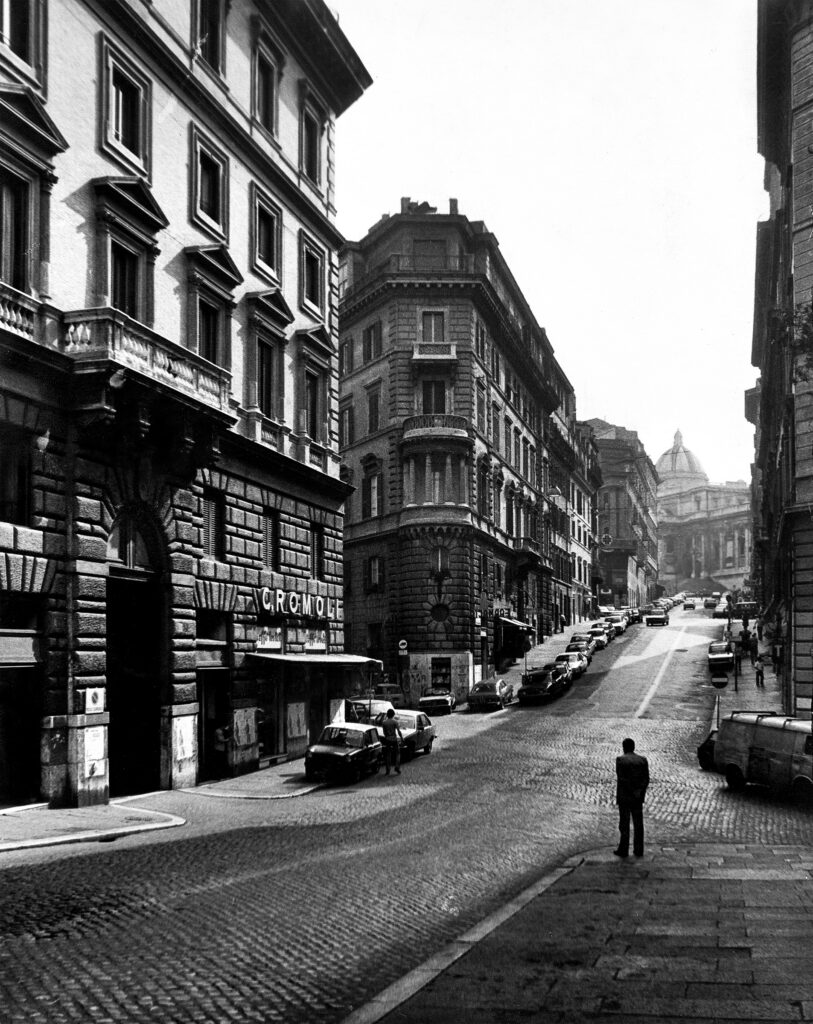
In A Roman Vista, the street unfolds like a long sentence written in stone. Windows repeat their dark syllables along the façades; cornices gather the light and release it in narrow shadows. Near the foreground, a solitary figure faces the city, while a dome rises faintly at the far end of the road. Between that small human presence and the distant curve, DVR gives the eye a journey—and gives the journey the hush of an unanswered thought.
The lines of the street draw us forward with an almost musical insistence. Kerbs, rooftops and the patient succession of parked cars seem to lean towards the distance, each carrying a little of our attention. Then the broad corner of the central building slows the movement. Its rounded edge holds the light differently from the flat walls around it. Here, DVR’s composition finds its cadence: a passage, a pause, and the invitation to continue.
Light travels over the masonry like a hand learning an unfamiliar face. It discovers the raised edges, leaves the windows deep, and lingers upon the ornament beneath them. The nearer stone is rich with texture; farther away, the buildings soften into paler tones. This gradual surrender of detail opens the photograph’s depth. We feel the distance because the city changes its voice as it recedes, from the strong articulation of the foreground to a quiet murmur beneath the sky.
The figure standing below is almost a small mark of ink upon the street. Yet the whole view feels different because he is there. His back is turned, his gaze withheld from us, and the open space ahead becomes both his view and ours. DVR gives the immense architecture this slender human measure. Stone may fill the frame, but it is the presence of someone looking that allows us to imagine standing there ourselves.
Underfoot, the cobbles scatter their small patterns across the light. Above them, windows answer in larger, more orderly repetitions. Between these rhythms, cars and figures keep the scene from becoming an exercise in geometry alone. The pale sky offers a place for the eye to rest. DVR’s skill appears in these changing densities: the photograph can be intricate without feeling crowded, expansive without losing the intimacy of a single person in a street.
When the eye reaches the distant dome, it wants to begin again. Back to the dark figure, back to the cobbles, back to the façades holding their fragments of sun. The composition makes return as rewarding as arrival. A Roman Vista becomes, for me, a poem about the pleasure of looking into distance: the world opens before us, beautifully ordered for one brief instant, while the road keeps something of itself beyond our reach.