
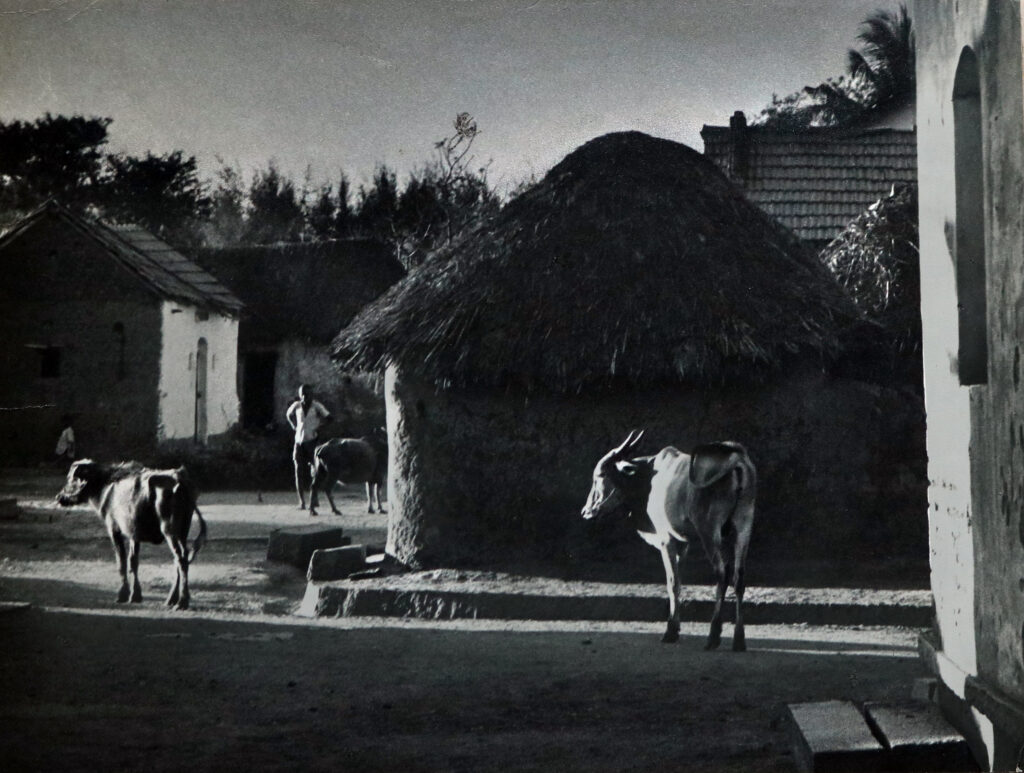
In An Evening Stroll, a thatched roof rises like a small hill of gathered shadow. Around it, cattle stand in the lane, walls catch the light, and a figure appears farther back between the dwellings. The scene has the closeness of an ordinary place seen without haste. DVR lets its rough surfaces and uneven spaces remain themselves, yet within them finds a rhythm so quietly persuasive that the eye begins to wander as though it already knows the way.
The central roof is the photograph’s deep, rounded note. To the left, a smaller roof slopes towards it; at the right edge, a pale wall rises almost straight, holding the scene in place. These unequal shapes give the composition its living balance. Nothing feels measured into sameness. DVR’s viewpoint reveals how the softness of a curve, the firmness of an upright and the pull of a diagonal can make a humble lane feel beautifully composed.
The cattle carry our attention from one depth to another. A form near the left foreground answers the larger animal against the central darkness; beyond them, smaller presences draw us towards the person standing back in the lane. Their positions make a loose, unhurried procession for the eye. The photograph is still, but looking through it has movement. DVR finds that movement in intervals—in the space an animal leaves around itself, in the little opening through which another becomes visible.
Light settles upon a flank, touches a horn, slips along a wall. These bright passages are modest, but they keep the darker forms distinct and give the scene its breathing room. The thatch does not collapse into a single black shape; the shaded lane still offers places for the eye to enter. Such tonal relationships carry much of DVR’s skill here. The shadows retain their depth, while the illuminated edges give us enough guidance to move among them.
The surfaces seem almost to remember touch. Fine strands of thatch break the light into small irregular marks; plaster receives it more broadly; the rough ground catches it in fragments. In monochrome, these differences become the photograph’s quiet abundance. We are invited to notice what colour might otherwise hurry us past: the grain of shelter, the weight of a wall, the changing texture of a path beneath the same fall of light.
What holds me finally is the ease with which all these things belong together. Roof, animal, figure and shadow share the frame without any one of them having to become an emblem. Through balance and the careful separation of tones, DVR gives ordinary life a lasting pictorial shape. An Evening Stroll lets us linger in that shape, tracing its small passages of brightness, until a familiar kind of lane begins to feel like somewhere we have only just learned to see.